Greetings!
Sunday morning. Coffee's hot. Last time, we talked about the basics that should already be in your house. This time, we're putting them in a bag.
Here's the difference between a checklist and a go-bag: a checklist lives on your fridge. A go-bag lives by the door. When you have to leave in ten minutes — or when the power, water, and 911 all fail at once — you don't want to go shopping through your own house. You want to grab one bag and go.
That's what this issue is: one bag, built from the 72-Hour Crisis Checklist, that covers you for three days.
The timing isn't accidental. This week, governments from the UK to Japan have been urging their citizens to stock up and prepare to get through several days on their own (read the story). When the official advice starts sounding like the checklist, it's a good week to build the bag.
On the personal front: I've started training for the Cleveland half marathon next May — ran Pittsburgh's earlier this year. Being ready isn't just about what's in the bag. It's about the person carrying it.

John on the orange wall.
Be Prepared Challenge
This week's challenge: build one go-bag from the checklist.
Not a bunker. Not a year's supply. One bag — a backpack or duffel — packed once and left by the door. Here's what goes in it, straight from the 72-Hour Crisis Checklist:
Water — 3 gallons per person, minimum. Heavy, so this part lives closest to the door (or in the car). Add a portable filter or purification tablets for refills.
Food — three days, no cooking required. Canned goods, peanut butter, energy bars, dried fruit — plus a manual can opener and paper plates, because there may be no water for dishes.
Warmth — blankets or a sleeping bag, and a cold-weather layer per person. Socks, hat, gloves. Hypothermia kills first. Add a tarp and duct tape.
Medical — a real first-aid kit with a commercial tourniquet, a 7-day supply of any prescriptions, plus pain reliever, antihistamine, and electrolyte packets.
Light & power — a flashlight (a headlamp is best) with spare batteries, a portable battery pack kept charged, and a battery or hand-crank radio.
Comms & info — emergency contacts written on paper (phones die), one local meeting point everyone in the house knows, and a paper map of your area.
Documents & money — copies of IDs, insurance cards, and prescriptions in a waterproof bag, plus $200+ in small bills. ATMs and card readers go down.
Hygiene — wet wipes, hand sanitizer, heavy-duty trash bags, and a portable toilet setup: bucket, bags, and kitty litter.
Tools — a multi-tool or fixed-blade knife, and fire starter: waterproof matches and a lighter.
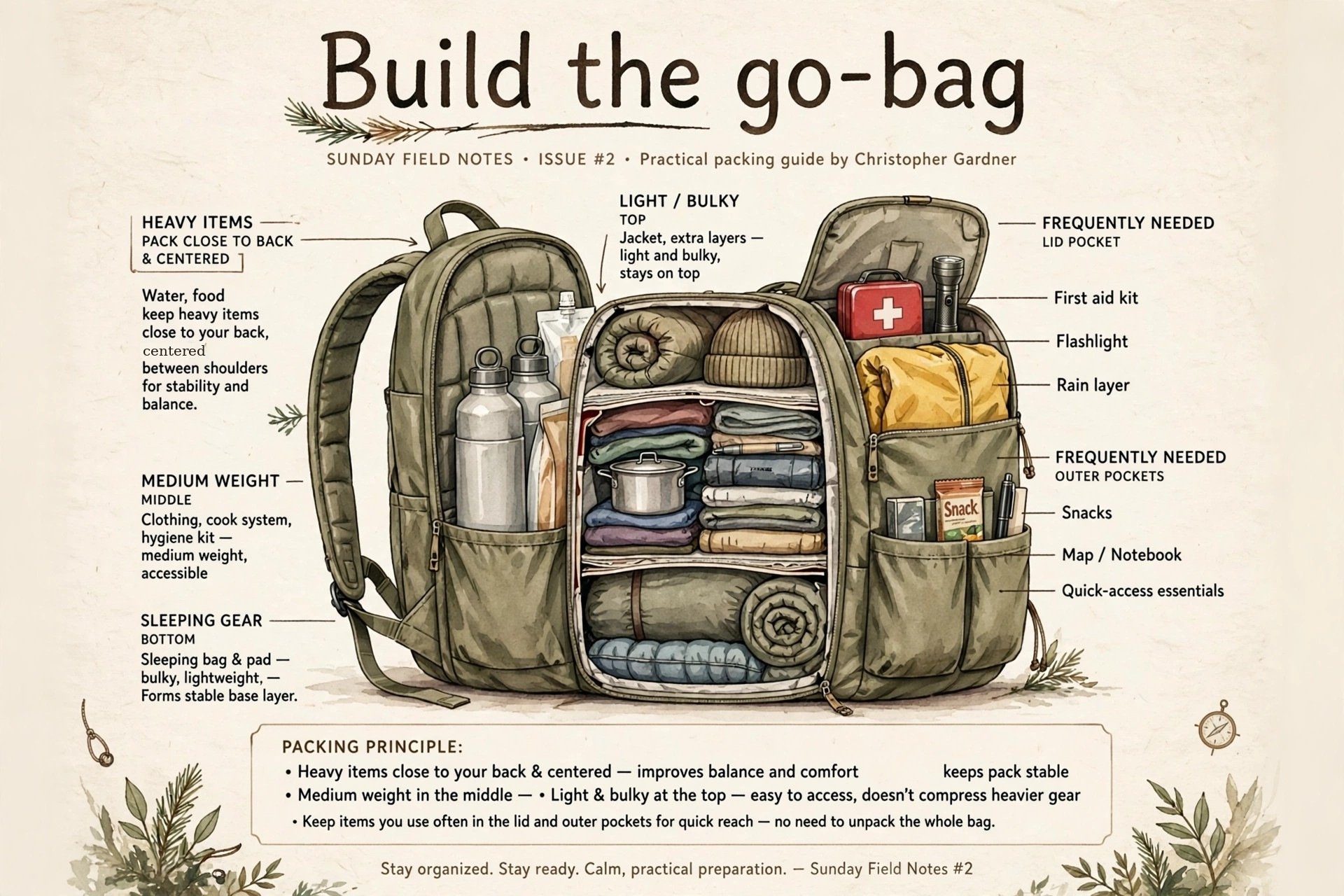
Pack it this weekend. Then — and this is the part everyone skips — put it by the door and leave it there. A go-bag in the attic is a storage bin.
If you get Sunday Field Notes by email, hit reply and tell me where your bag lives — I read every response.
Keep Exploring
New on Field Notes: "Our 72-Hour Survival Checklist, Explained" — the full section-by-section walkthrough of the checklist this bag is built from: https://www.chrisgardnerbooks.com/field-notes/our-72-hour-survival-checklist-explained
The 72-Hour Crisis Checklist itself: the full printable checklist this bag is built from — get it here.
Ready.gov's emergency kit checklist: ready.gov/kit — the official version, worth comparing against yours.
From the Bookshelf
Foundation and Empire — Isaac Asimov (1952). I'm in the middle of the Foundation series right now, and this is the book where the Galactic Empire actually starts to fall — the Foundation racing to preserve civilization's knowledge while everything collapses around it. If my books are your speed, this is the grandfather of the whole genre.
On the books
I'm deep in edits on my historical novel, The Paper Country. The Other Side of the Sun series is three books strong, and The Truth Makers is a brand-new series — details at chrisgardnerbooks.com.
See you in two weeks.
— Chris

Sunday Field Notes goes out every other Sunday. Get the printable 72-hour checklist and the next issue here: https://chris-gardner.kit.com/f99d663020
